Flowers for the Mother of Pan-Europe
The first female pioneer of a united Europe, the Jewish actress Ida Roland, who was a celebrated stage star, died 70 years ago - on 27 March 1951.
Ida Roland was married to Richard Count Coudenhove-Kalergi from 1915 until her death. From 1922, she worked with him to establish the Paneuropa Union, the oldest European unification movement.
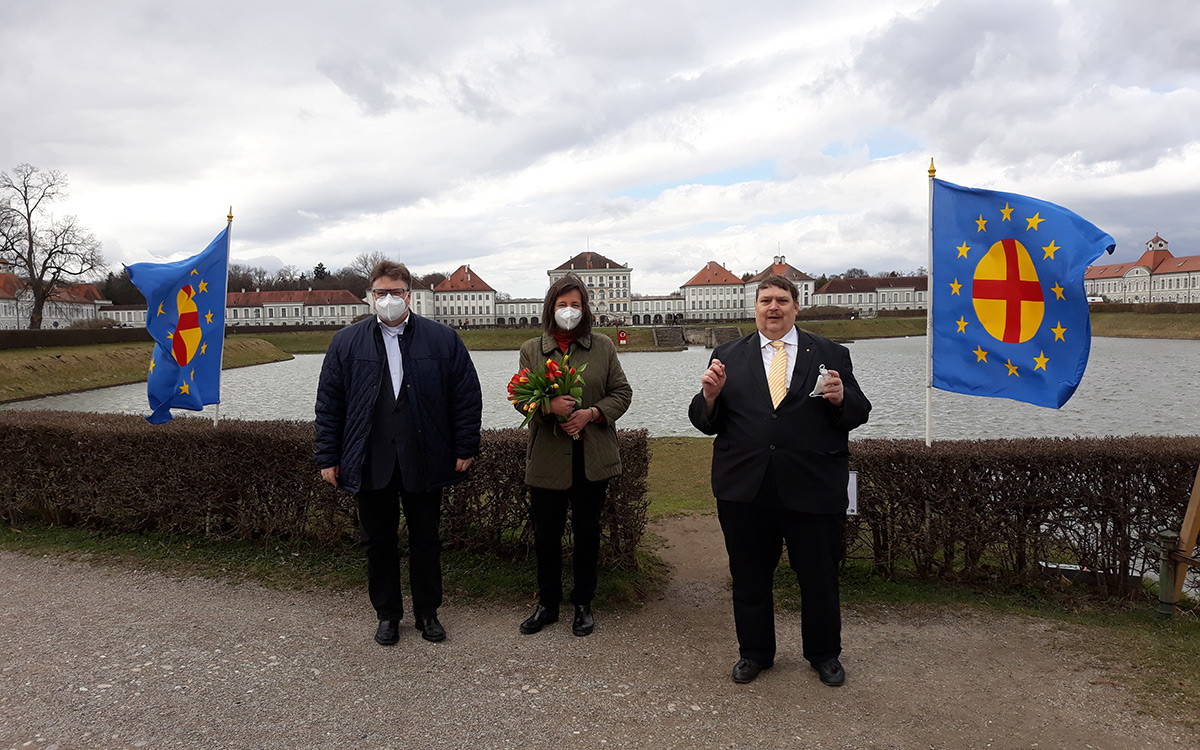
To mark the 70th anniversary of her death, a delegation from the Paneuropa Union Germany gathered at Nymphenburg Palace in Munich, where the couple had been married.
Paneuropa President Bernd Posselt, long-time Munich MEP, together with Federal Managing Director Johannes Kijas and Press Officer Stephanie Waldburg, scattered spring flowers in the Nymphenburg Canal, which runs not far from Romanstraße, where the diva lived during her time in Munich, in memory of the ‘Mother of Pan-Europe’.
The Pan-Europeans had already taken 18 February, the 140th birthday of the artist, as an opportunity to declare 2021 an ‘Ida Roland Year’. The first event was the small ceremony at the Nymphenburg Canal, which will be followed by further activities.
Curriculum vitae of the Mother of Pan-Europe
Born Ida Klausner in Vienna in 1881, Ida Roland, as her stage name was, attended drama school in her home town and made her debut at the Innsbruck City Theatre at the age of 17. The multilingual and highly educated actress initially had engagements in Ulm, Düsseldorf and Berlin, where she worked under Max Reinhardt at the Deutsches Theater and the Hebbel-Theater from 1905 to 1908. In 1911, she moved to the newly founded Münchner Kammerspiele theatre, which was directed by Eugen Robert at the time. When her relationship with him broke down, she returned to the Danube metropolis, celebrated by the spoilt Viennese audience, where she met the Bohemian-born Richard Coudenhove-Kalergi, son of an imperial and royal diplomat and a Japanese woman. She met the Bohemian-born Richard Coudenhove-Kalergi, the son of an imperial and royal diplomat and a Japanese woman, and became enthusiastic not only about him but also about his ideas for the creation of a United States of Europe. From then on, she dedicated her entire life to this goal. She brought her young husband into contact with artists, intellectuals and writers, such as Thomas Mann, Franz Werfel, Rainer Maria Rilke and Stefan Zweig, who were to become supporters of the Pan-European movement. From 1915, she appeared again at the Kammerspiele and lived in Munich's Romanstraße, not far from Nymphenburg Palace, in whose chapel the court curate Count Franz Walderdorff married her and Coudenhove in church.
The marriage was extremely happy, and in 1926 Ida Roland organised and staged the first Pan-European Congress in the Vienna Konzerthaus with more than two thousand prominent participants from 24 European countries. The cultural highlight of this first major European event in history was a gala performance at the Burgtheater, in which she played the title role of Rostand's ‘L'Aiglon’. In the years that followed, the couple travelled continuously throughout Europe to establish member organisations of the Pan-European Union and maintained contact with the leading politicians of the time, above all France's Foreign and Prime Minister Aristide Briand, who advocated reconciliation with the ‘hereditary enemy’ Germany, who assumed the honorary presidency of the Pan-European Movement, and the Czechoslovak President Tomáš Garrigue Masaryk, who, like Ida Roland's mother, was born in Göding/Hodonín in south-east Moravia.
In 1938, when Austria was annexed, the couple, persecuted by the National Socialists, had to flee to America via Switzerland, where Coudenhove, together with his later successor Otto von Habsburg, lobbied US President Franklin D. Roosevelt for a united Europe. Roosevelt in favour of a united Europe as an idea for peace in the post-war period. Ida and Richard Coudenhove organised a much-noticed exile congress of the Pan-European Union at New York University to shake up the American public. Immediately after the end of the war, Ida Roland, together with the exiled Empress Zita of Austria, founded ‘Austrian Relief’ in the USA, an aid organisation to help starving and freezing Austrians.
Back in Europe, the couple began to mobilise the parliaments of the free part of the continent for European unification. The first fruit of these activities was the founding of the Council of Europe in Strasbourg in 1949.
Paneuropa Press Office, Stephanie Waldburg